You Are Not Your Mind
Inspired by the chapter "What Is The Mind?" in Atmamun. Original commentary, not a summary or reproduction of the book.
Start with what you can check
Most talk about the mind stays abstract. The chapter this story draws on does the opposite. It asks you to begin with your own day and test every claim against your own experience.
Think back over today and ask three questions. How many thoughts did you have? How many moods did you pass through? How much of it did you choose? If you are like most people, the honest answers are "too many to count", "several" and "very little".
Everything arrives through a filter
Every experience you have reaches you through the mind. The mind does not only receive the world, it also colours it, the way a lens tints a photograph. Irritation, sadness, competitiveness and hope show up as facts about the world. On closer inspection they are the mind's reaction to the world. A reaction can be watched. A fact has to be obeyed.
The mind is not a villain
A common mistake is to decide the mind is bad and try to defeat it. The chapter rejects that view. The mind is neither good nor bad. It is a fast, active tool that runs whether you ask it to or not. The trouble begins with identification. When you believe "I am my mind", every passing worry becomes your worry.
Why positive thinking is not the exit
A cheerful thought is still a thought. You have changed the content and kept the machinery running. The alternative is understanding: seeing thought for what it is and no longer taking each one as an order.
A picture worth keeping
The book uses the image of a dog running wildly around a yard. The dog does not bother you until you are tied to it. The rope is the belief that you are the mind. Cut the belief and the dog can run all day while you sit still.
Try this for one week
- Morning: before checking your phone, spend one minute noticing thoughts arrive. Do not follow them. Just note "thought".
- Midday: when you feel irritated, ask, "Is this the world, or my mind's reaction?"
- Evening: write down one moment you felt at ease today.
The 21-Day Mind Watch challenge turns this into a daily habit.
Educational reflection, not medical or psychological advice. If you are struggling with anxiety or low mood, please speak to a qualified professional.
New articles by email
One new article a week, free. No spam. Unsubscribe anytime.
More in Philosophy

Philosophy · 3 min read
Steady and Easy: The Only Rule of a Pose
Patanjali gives one test for posture in the Yoga Sutras. Here is how to apply it in any pose today.

Philosophy · 3 min read
Showing Up Without Keeping Score
The Gita describes yoga as evenness of mind. What that means for streaks, challenges and off days.
Keep reading

Breath & Meditation · 3 min read
Why Every Session Begins with Breath
Old hatha texts treat breath as the way to steady the mind. A six-breath opening you can use before any practice.
Poses · 4 min read
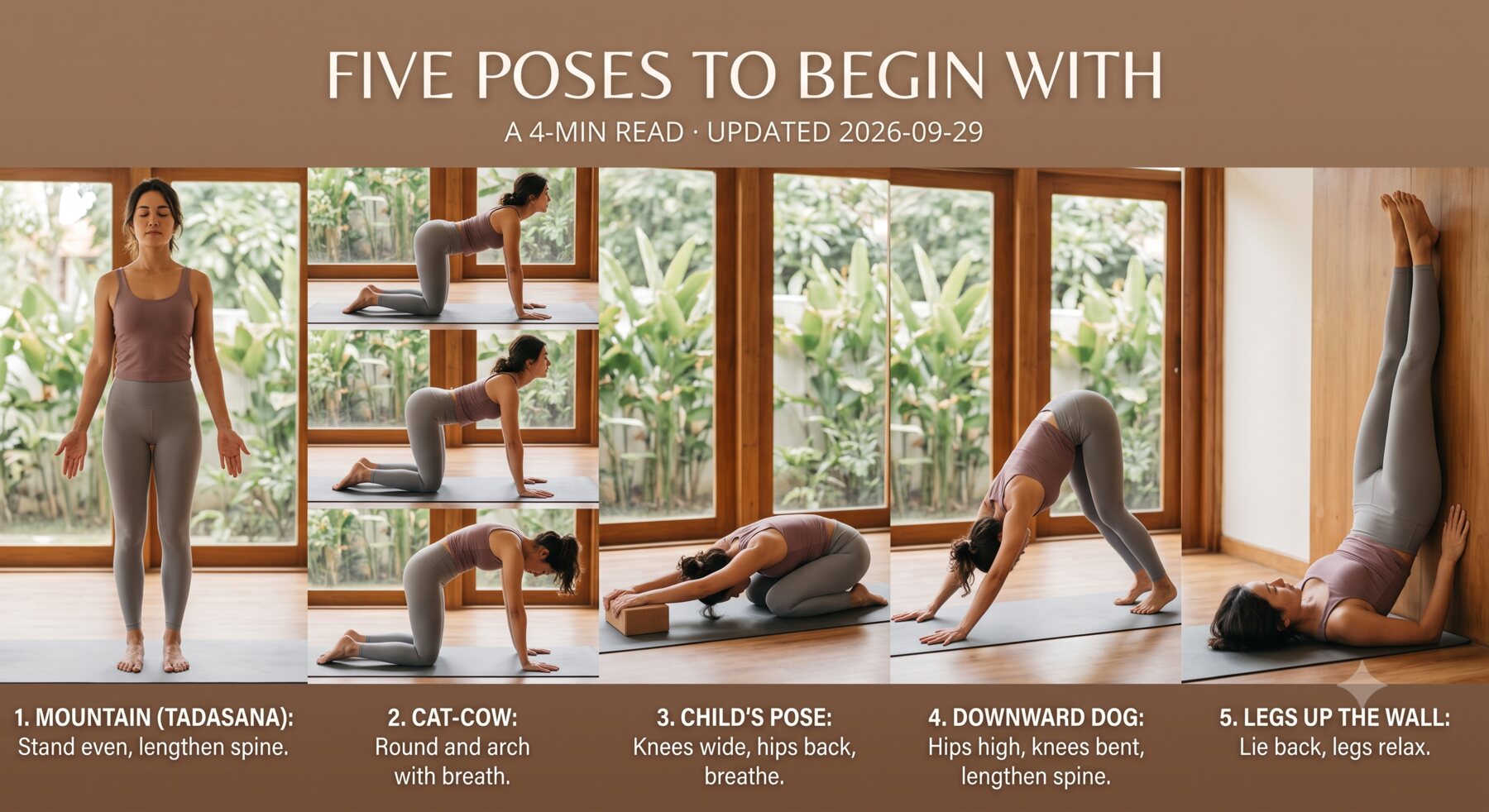
Five Poses to Begin With
A short list of foundation poses for beginners, with what to notice in each.

Breath & Meditation · 4 min read
How to Sit for Five Minutes
A simple beginner method for sitting still, with what to do when your mind runs off.