Mindful Breathing Exercise: A Step-by-Step Guide Based on Thich Nhat Hanh

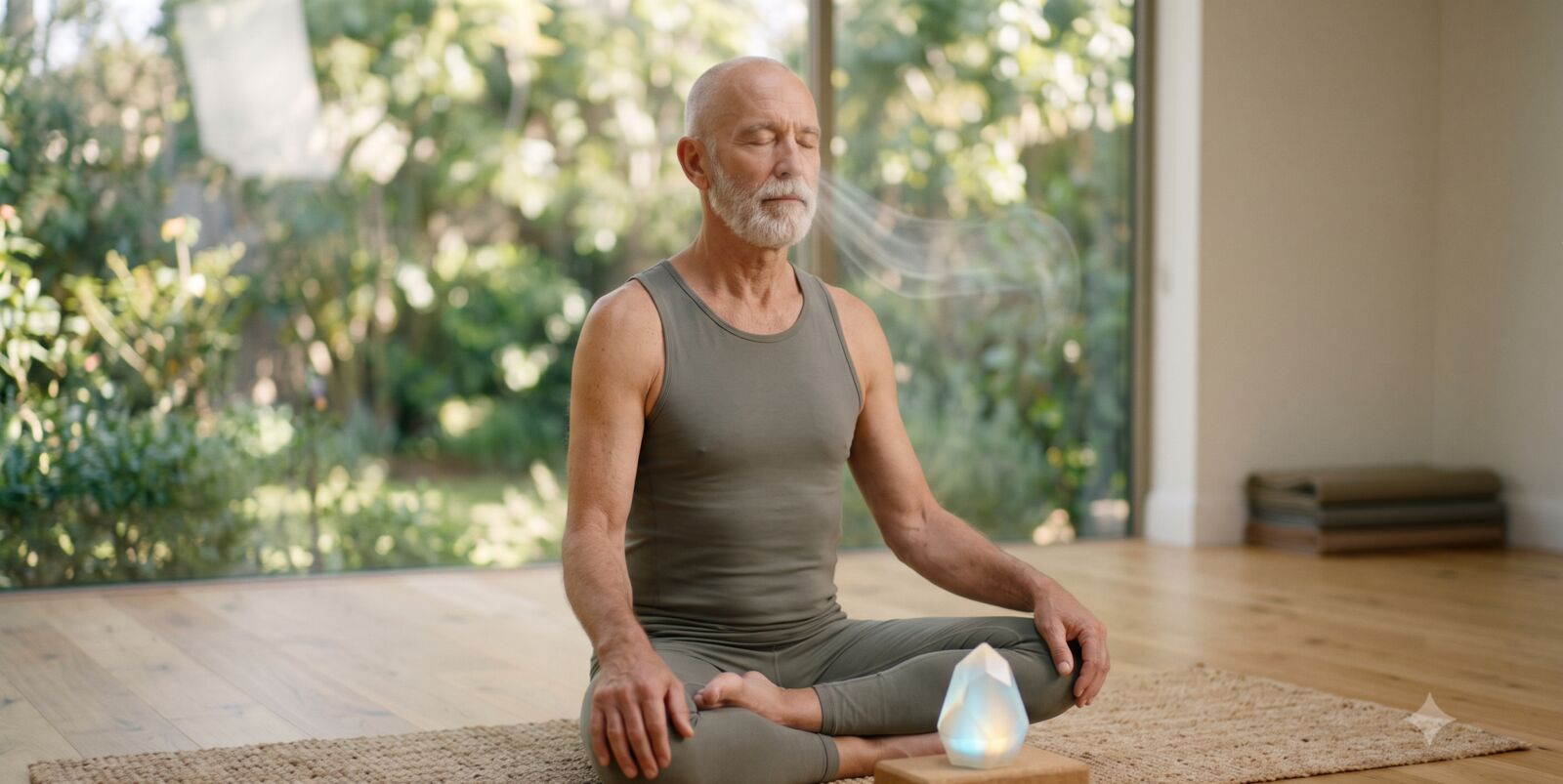
Mindful breathing means knowing you are breathing in when you breathe in, and knowing you are breathing out when you breathe out. Thich Nhat Hanh's Making Space teaches it with short silent phrases and asks you not to force the breath. A few breaths, or a minute or two, is enough to begin.
You have taken roughly twenty thousand breaths today, and you noticed almost none of them. That is not a criticism. Breathing is designed to run without you. But it means you are carrying around a free, portable anchor for your attention and never using it.
Making Space treats mindful breathing as the starting point of everything else in home meditation, and it explains it in a page or two. This guide takes that idea and turns it into a practice you can learn in a minute, deepen over a week and use in the middle of an ordinary Tuesday.
The one idea: knowing
Mindful breathing is not a special way to breathe. It is knowing that you are breathing. The book describes the breath as a bridge between body and mind. In daily life your body is often in one room while your mind is in another, or in another year. The moment you breathe in and are aware that you are breathing in, the two meet. You have begun.
That is all. You do not need to slow the breath, deepen it or count it. You only need to know it.
Try it now: the 60-second version
- Stop. Stop reading for a moment. The book calls stopping the first step.
- Settle. Feel your weight in the chair or under your feet.
- Breathe in and name it. Silently: “Breathing in, I know I am breathing in.”
- Breathe out and name it. Silently: “Breathing out, I know I am breathing out.”
- Repeat for six breaths. Do not try to improve anything.
- Notice. Before you start reading again, check how your body feels.
Most people notice something small: a loosened jaw, a lowered shoulder, a slightly longer exhale. The book compares the practice to a children's game. It is simple, and the effect is large.
The practice in five layers
Think of mindful breathing as five layers, each adding one thing to the last. Stay on each layer for as long as it feels natural.
Layer 1: Name it. In-breath, out-breath. The words are training wheels. When you no longer need them, drop them.
Layer 2: Make it easy. The book says not to labour the breath. Let it flow easily and quietly. If you find yourself gripping it, you are trying too hard. Breathing can and should be enjoyable, the book says, and as you continue, the breath tends to become deeper and slower by itself.
Layer 3: Soften the body. Add a second pair of phrases. Breathing in, notice the tension in your body. Breathing out, let it go. Go looking for it: forehead, jaw, shoulders, hands, belly.
Layer 4: Add a smile. The book says a smile can relax hundreds of muscles in your face and shows that you are in charge of yourself. Let it be small and real, not a pose.
Layer 5: Rest in the moment. The book offers a four-line practice that you can shorten to four words, one for each breath: calming, smiling, present moment, wonderful moment. The book's own images help. Breathing in and calming the body is like drinking a glass of cold water on a hot day, and you can feel the coolness spread. While you sit, you are not thinking of anything else, and you know exactly where you are.
The last line carries a question the book wants you to take seriously. If you cannot find peace and joy right now, how will you find them tomorrow? Your appointment with life, it says, is in the present moment.
What five minutes actually feels like
Beginners often assume that a good session is a quiet one. It is not. Here is a realistic five minutes:
- Minute 1. Thoughts are loud. You notice the noise of the room, an itch, a to-do list. Normal.
- Minute 2. You lose the breath completely and notice you were planning dinner. You return. This return is the practice.
- Minute 3. For a few breaths the mind is quieter. You may feel a little impatient with the quiet.
- Minute 4. The body settles. The shoulders drop a little.
- Minute 5. You are not sure it worked. It did. You stopped.
The book asks you to sit only to enjoy sitting, with no goal to reach. Each moment of sitting, it says, brings you back to life.
Twelve places to practise in real life
The book suggests using reminders throughout the day. Anything can be one: an altar, the chime of a clock, a bell, a sitting corner, a picture, even birdsong, a dog barking, a passing plane or a siren. Here are twelve everyday cues, our suggestions built on that idea:
- The moment the kettle clicks.
- Before you open your email.
- Each time your phone rings, before you answer.
- Standing in a queue.
- Waiting for a lift.
- The first minute after you sit down at your desk.
- After you close the front door behind you.
- Before you put a spoon in your mouth (see Mindful Eating).
- While the shower warms up.
- At a red light, keeping your eyes on the road and your attention on the drive.
- On the bus or train, instead of reaching for your phone.
- The moment you turn off the light at night.
Pick two and practise only those for a week. You can also hang a sign that says “Breathe”, or set a bell sound on your phone to ring every so often. Even a few breaths or a minute or two is valuable, the book says.
The mountain, when you sit
When you are sitting, the book offers an image to pair with the breath: breathing in, see yourself as a mountain; breathing out, feel solid. It fits the book's idea that stability in the body helps you find stability in the mind. If you feel scattered, sit a little taller and imagine your weight settling downward, like a mountain that does not have to try.
When your mind wanders
It will, hundreds of times. Some things to remember:
- The wandering is not the failure. Noticing it is the practice.
- Sounds are welcome. The book says the sights and sounds of the world are not your enemies. They can be part of your awareness, like birdsong in the background.
- Distraction is forgetfulness. The book says distraction comes only when mindfulness is absent. So when you remember, you have already returned.
- Return kindly. Come back to the next breath without a lecture.
- Shorten the session. If a sit feels like a fight, try one minute, three times a day.
Mistakes that make it harder
- Trying to breathe deeply. The book says not to force it. The breath deepens on its own.
- Judging the session. There is no score.
- Thinking it is mental hard labour. The book says meditation is not hard work. It rests the mind.
- Waiting for the perfect place. You can do it anywhere, and the book says you can practise at work, while driving or on the bus once it is familiar at home.
Use it when you are upset
The book pairs breathing with a place. When you are uneasy, sad or angry, go to your breathing corner, invite the bell and breathe for ten or fifteen minutes. If that is not possible, take three breaths where you are before you say or do anything. See How to Create a Meditation Space at Home.
A seven-day plan
- Day 1. The 60-second version, once.
- Day 2. Twice: morning and evening.
- Day 3. Add a cue from the list of twelve.
- Day 4. A three-minute sit, with the softening layer.
- Day 5. Add the smile.
- Day 6. Five minutes with the four-word practice.
- Day 7. Sit for five minutes and write down one thing you noticed.
You can pace the breath with our breath pacer on days when you want something to follow.
A caution
For most people, simply noticing the breath is gentle. But if focusing on your breathing makes you anxious, dizzy or short of breath, stop and switch to another anchor, such as your feet on the floor. If you have a lung or heart condition, or the discomfort continues, talk to a health professional.
This article is general educational information about a mindfulness practice, not medical advice.
Frequently asked questions
What is mindful breathing?
Knowing that you are breathing in when you breathe in and breathing out when you breathe out, without trying to change the breath. In Thich Nhat Hanh's Making Space it is described as a bridge between body and mind.
How do you do the Thich Nhat Hanh breathing exercise?
Stop, settle, then silently name each breath: breathing in, I know I am breathing in; breathing out, I know I am breathing out. The book then adds phrases for releasing tension and a short four-word practice.
How long should I do mindful breathing?
Even a few breaths or a minute or two is valuable, according to the book. Start with sixty seconds, then build to five minutes. When you are upset, the book suggests ten or fifteen minutes.
Should I breathe deeply?
No. The book says not to labour the breath. Let it flow easily, and it will naturally become deeper and slower.
What if my mind keeps wandering?
Return to the next breath and do not judge yourself. The book says distraction comes only with forgetfulness, and that sights and sounds can simply be part of your awareness.
Where can I practise mindful breathing during the day?
Anywhere. The book suggests reminders such as a bell, a clock chime, a sign that says breathe, or even birdsong and sirens. Good everyday cues are the kettle, a queue, a red light and before opening email.
Is mindful breathing safe for everyone?
It is gentle for most people. If focusing on the breath makes you anxious or short of breath, stop and use another anchor, and speak to a health professional if it continues.
Sources and further reading
- Thich Nhat Hanh, Making Space: Creating a Home Meditation Practice (Parallax Press, 2012; updated edition 2026)
Summaries and step-by-step guidance here are our own plain-language commentary based on the book. Read the book itself for the full text, verses and the tradition behind them. The Slow Breath is independent and is not affiliated with, or endorsed by, Thich Nhat Hanh's Plum Village community or Parallax Press.
New articles by email
One new article a week, free. No spam. Unsubscribe anytime.
More in Breath & Meditation

Breath & Meditation · 13 min read
How to Create a Meditation Space at Home, Even in a Small Room
Set up a meditation space tonight in fifteen minutes. A practical guide for small homes, shared rooms and busy families, with a first-week plan and fixes for the problems that make most home spaces fail. Inspired by Thich Nhat Hanh's Making Space.

Breath & Meditation · 9 min read
Loving-Kindness (Metta) Meditation for Beginners: A Step-by-Step Guide
A complete beginner's guide to metta (loving-kindness) meditation: the five stages, a twelve-minute guided practice in plain words, how to handle a difficult person safely, and a 14-day plan. Inspired by Thich Nhat Hanh's Making Space.
Breath & Meditation · 3 min read
Why Every Session Begins with Breath
Old hatha texts treat breath as the way to steady the mind. A six-breath opening you can use before any practice.
Keep reading

Practice · 8 min read
Mindful Eating: How to Eat a Meal in Mindfulness, Step by Step
A practical guide to mindful eating at home: the meal in eight moments, a 30-second trace-the-food exercise, a five-question pause card, how to run a silent meal, and a seven-day plan. Inspired by Thich Nhat Hanh's Making Space.

Practice · 7 min read
Deep Relaxation Before Sleep: A Body Scan You Can Do in Bed
A full deep relaxation practice for bedtime, with a spoken script in plain words, a two-minute version, tips for waking in the night and a seven-night experiment. Inspired by the sleeping chapter of Thich Nhat Hanh's Making Space.

Practice · 7 min read
The Cake in the Refrigerator: A Simple Way to Calm an Argument at Home
A simple family practice for calming an argument at home: three breaths, one agreed phrase and a cup of tea. Steps, sample dialogue, a five-minute set-up for your household and safety notes. Inspired by Thich Nhat Hanh's Making Space.